Lesson 21: Describing Bivariate Data; Scatterplots, Correlation, and Covariance
Homework
Solutions
Please note that the steps show rounded numbers, but that the final answers to the problems are calculated without rounding.
| Problem | Part | Solution |
|---|---|---|
| 1 | - | Linear, moderate negative association. |
| 2 | - | Linear, strong positive association. |
| 3 | - | Linear, moderate positive association. |
| 4 | - | Nonlinear. |
| 5 | - | Linear, moderate positive association. |
| 6 | - | Linear, weak positive association. |
| 7 | - | c. There is a strong negative linear relationship between the variables. |
| 8 | - | 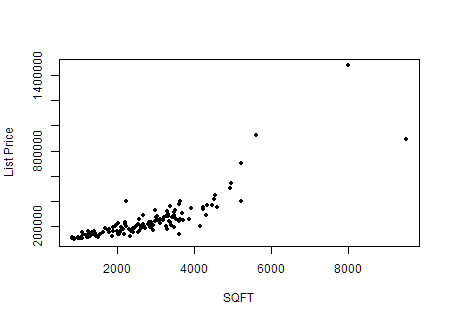 |
| 9 | - | Answers will vary. One plausible answer is that it does appear to be linear, with a strong positive association. You may also see slight curve to the data. |
| 10 | - | r = 0.843 |
| 11 | - | If in answer to question 9 you said that the data appear to show a strong positive association that is supported by r = 0.843 because it is a positive number and it is close to 1. |
| 12 | - | Sxy = 178, 852, 397 |
| 13 | - | 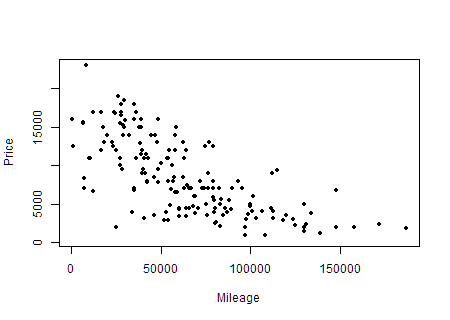 |
| 14 | - | Answers will vary. One plausible answer is that it does appear to be linear, with a moderate negative association. |
| 15 | - | r = −0.687 |
| 16 | - | If in answer to question 14 you said that the data appear to show a moderate negative association that is supported by r = −0.687 because it is a negative number and it is right in between 0 and -1. |
| 17 | - | Sxy = −125, 854, 295 |